Where did the money go?
At some point most people look at their bank account and wonder where it went. Not because they spent on anything obvious. It just went. Here's why that happens and what to do about it.

Most people have a number in their head for what life costs each month. Not an exact number, but something that feels close enough. The rent or mortgage is easy to remember, the main bills are familiar, and groceries feel like they sit somewhere around a usual amount. Eating out is probably “not too bad”, and subscriptions are just a few small things in the background.
The problem is that the number in your head often isn't measured. It's remembered. And memory has a habit of cleaning things up. It remembers the main supermarket shop, the regular bills and the week that felt typical. It leaves out the top-up shop, the lunch between meetings, the Uber home, the pharmacy run, the annual insurance payment and the subscription that renewed quietly while you were busy doing other things.
That's not because you're bad with money. It's because a real month has too much detail for your brain to hold neatly. Spending is spread across accounts, cards, automatic payments and one-off costs, then compressed into a rough story that feels true enough. But often, the story is missing some important chapters.
This was personal for us
For us, this wasn't just a theory. We were both working hard in full-time jobs and genuinely thought we were doing well towards the goal we cared about. On paper, it felt like all that effort should be turning into progress. We weren't living wildly, and we didn't think we were being careless. We just assumed that because we were working hard and earning steadily, the numbers would be moving in the right direction.
Then we actually sat down and did the maths properly. Not the rough version in our heads, but the real version: what was coming in, what was going out, and what was truly left over. It was confronting. We were surprised by how little we were saving compared with what we thought our hard work should have produced, and by how small the total we'd saved felt against the goal we had in mind.
The first feeling wasn't motivation. It was disappointment. We felt upset and, honestly, a bit like failures, as if all those long weeks and full-time hours had somehow been wasted. Looking back, that wasn't the right conclusion. The work hadn't gone to waste. We just didn't have a clear enough picture of where the money was going, which meant we couldn't make the trade-offs deliberately.
What your brain calls normal is not the whole month
When people estimate spending, they usually picture a tidy month. Four weeks, regular bills, a grocery shop, a few coffees, a dinner or two, maybe a tank of petrol. It's the kind of month that sounds normal when you say it out loud, and it's often the version we use when we tell ourselves life should be costing a certain amount.
Real months are rarely that tidy. One has a car service, another has a dentist appointment, and another has school costs, flights, clothes, a wedding, Christmas, a higher power bill or three birthdays in the same week. Each expense might feel like an exception, so it doesn't make it into the mental estimate of a normal month.
The trouble is that over a full year, exceptions aren't really exceptional. Something always comes up. If your mental budget only works in a quiet month, it's probably not describing your real cost of living. It's describing an ideal month, and ideal months don't happen often enough to build a plan around.
Small spending is hard to feel in real time
Big purchases usually leave a mark. You remember buying the furniture, paying for the trip or replacing the phone because those purchases feel like decisions. Small spending feels different. It slips into the day. A coffee on the way to work, lunch because you didn't have time to pack anything, a supermarket top-up, a takeaway after a long day, a few things added to an online cart because they were useful enough to justify.
None of those choices has to be wrong. A lot of them are perfectly reasonable. The issue is that they don't feel like a spending category; they feel like life happening. By the time you look back, the total can be much larger than the feeling of the individual purchases.
Categories make it even trickier. A supermarket shop might include groceries, wine, cleaning products and a present. A trip to Kmart or The Warehouse might be half practical and half impulse. A food merchant might be lunch, groceries, treats or convenience depending on the day. Your brain does its best, but it isn't built to categorise hundreds of transactions accurately from memory.
Multiple accounts can hide the real picture
Another reason spending is hard to estimate is that it rarely happens in one clean place. Rent might leave one account, groceries another, subscriptions a card you barely check, and bigger purchases a credit card that gets paid off later. Transfers between accounts can make things look organised, even when the total picture is still unclear.
Credit cards are especially good at creating timing confusion. This month can feel fine because the money hasn't left your main account yet, but the spending has already happened. Separate accounts can be useful, but they can also make it harder to answer the basic question: what does our life actually cost?
That's why your bank balance isn't the same as your budget. A balance is only a snapshot. It doesn't know which money is already spoken for, which bills are about to arrive or which expenses are sitting somewhere else.
The real number matters more than people think
Knowing what you actually spend isn't only useful for this month's budget. It sits underneath almost every bigger financial decision. How much emergency fund do you need? How quickly could you pay down debt? Could you afford to buy a home, reduce your hours, take a career break or move towards financial independence? Every one of those questions depends on your real baseline spending.
If that baseline is a guess, the plan built on top of it is a guess too. It might still point you in the right direction, but it will probably feel frustrating when reality keeps pushing against it. A small error each month can become a big difference over a year, and an even bigger difference over the life of a long-term goal.
This is why the first look at real spending can feel uncomfortable. Not because the spending is automatically bad; sometimes it makes complete sense for your life. The uncomfortable part is seeing that the gap between what you thought was happening and what actually happened is big enough to change the timeline on things you care about.
The goal isn't guilt. It's clarity.
Once you have a truer picture, the conversation changes. Instead of “Why am I bad with money?”, the question becomes “Does this spending match the life I actually want?” That's a much more useful place to start, because it gives you room to be honest without turning the whole exercise into self-criticism.
Some categories may be higher because they genuinely matter to you. Maybe travel, meals with friends, convenience or hobbies are worth the money. Other costs may be less satisfying: old subscriptions, random purchases, habits that started during a busy season and never really stopped. Seeing the difference helps you decide what to keep and what to change.
What helps is looking at what actually happened over time. One month can tell you something, but it can also be misleading. Three months is better. Twelve months is better again, because annual bills, seasonal costs and irregular expenses finally show up. The aim isn't to judge every transaction; it's to build a baseline you can trust.
That experience is one of the reasons we built Fireball
Fireball connects to your NZ bank accounts and builds the picture from real transaction data instead of rough estimates. It helps group spending into useful categories, highlight recurring payments, show top merchants and surface the patterns that are difficult to spot when you're only looking at a normal bank feed.
The point isn't to turn every purchase into a moral judgement or make your finances feel like homework. It's to give you a baseline you can trust. Once you can see what's genuinely safe to spend, what is already committed and how your everyday choices affect your bigger goals, you can make decisions with much more confidence.
For us, the turning point was realising that hard work on its own wasn't enough. We also needed visibility. Without it, we were putting in the effort but still guessing at the outcome. With a clearer picture, the same income could be directed with much more intention.
Follow the money in Fireball
Fireball works as an NZ spending tracker by bringing connected transactions into several useful views. Each one answers a different question.
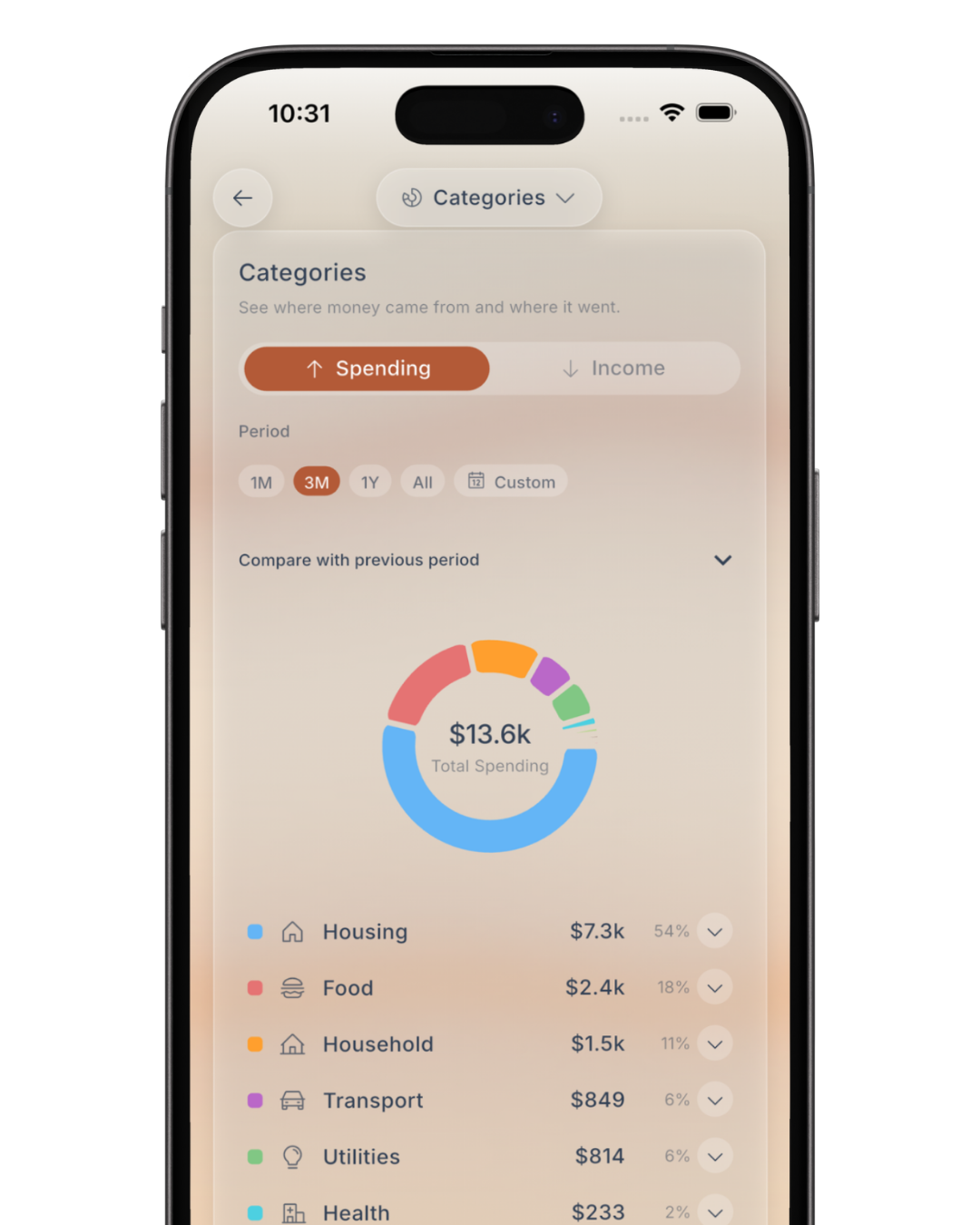
- Categories shows which income and spending areas account for the largest amounts and how they compare with earlier periods.
- Top Merchants shows where the most spending went, which can reveal a pattern hidden inside a broad category.
- Cash Flow explains the movement during a selected month using recognised income and categorised spending.
- Recurring activity helps you review repeated bills, subscriptions, and income that can disappear into the background.
- Cash Savings Rate shows how much recognised income remained after expenses, rather than counting transfers between your own accounts as new savings.
Start with the view that matches the question bothering you. If groceries look high, open the category and review the transactions. If the account balance is lower than expected, look at Cash Flow and recurring activity. If you moved money to savings but still feel no further ahead, check Cash Savings Rate.
The totals depend on the transactions behind them. Correct an income, category, split, or transfer only when the current treatment is wrong. The aim is not to make the chart look better. It is to make the explanation match what actually happened.
A better plan starts with a truer number
There's nothing strange about being surprised by your spending. Plenty of people are, because plenty of people are working from memory until they see the data in one place. The useful part is what happens next: you can decide what to keep, what to reduce and what deserves a more deliberate place in your budget.
A good income can still feel confusing when the picture is incomplete, but when your spending is based on reality rather than guesswork, the fog starts to lift. You can stop wondering where the money went and start deciding where it should go next.
Make the next money decision calmer
Turn what you just read into a plan you can track, adjust, and actually live with. Explore our free financial calculators or see how Fireball brings your finances together.