Why we buy things we don't need
Why do we keep buying things we don't really need? Discover how emotions, habits and modern marketing shape our spending, and how to make more intentional money decisions.
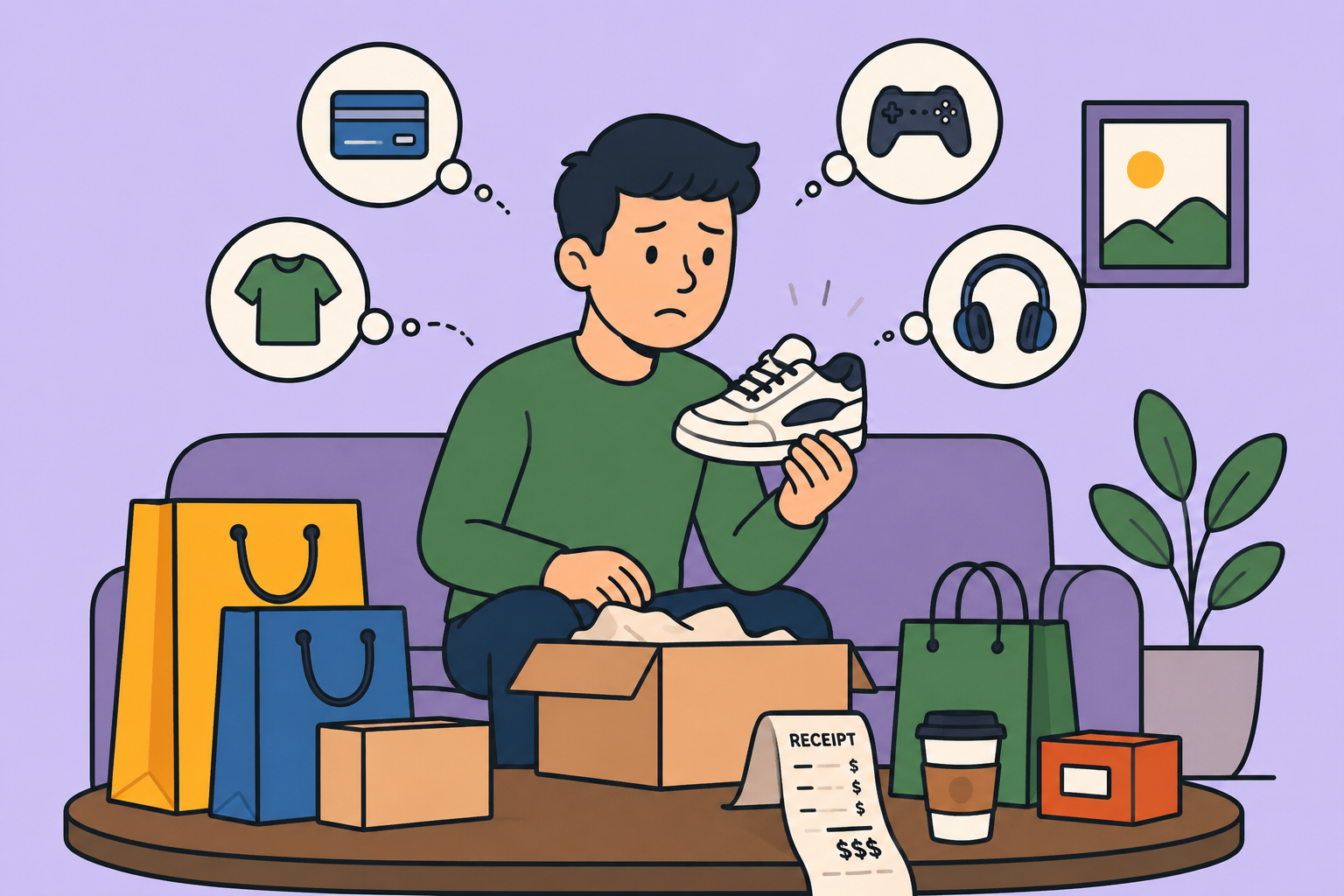
Modern spending isn't just about self-control. It's about understanding the world designed to influence us.
Have you ever bought something that felt like a great idea at the time, only to wonder a few weeks later why you bought it at all?
Maybe it was a kitchen gadget you were convinced would make cooking easier. A new jacket that still has the tags on it months later. Another streaming subscription because there was one show you wanted to watch. Or perhaps it was something much smaller—a few online purchases that didn't seem significant individually but somehow added up to far more than you expected.
Most of us have experienced this.
It's easy to blame ourselves and think we simply lack discipline or willpower. Personal finance advice often reinforces that idea by telling us to "stop impulse buying" or "be more disciplined."
The reality is much more complicated.
We don't make spending decisions in isolation. Every day we're surrounded by advertisements, algorithms and businesses designed to capture our attention and encourage us to spend. At the same time, our own brains are wired to seek convenience, novelty and immediate rewards. When those two forces meet, buying things we don't really need becomes surprisingly easy.
Understanding that doesn't remove responsibility.
It simply explains why managing money today is much harder than it used to be.
Shopping has changed more than we realise
Imagine buying something thirty years ago.
You'd probably drive to a shop, spend time looking around, carry the item to the checkout and hand over cash or a card. Every step created a small pause. Those pauses gave you time to reconsider. Perhaps you'd decide the item wasn't worth it after all.
Today, most of those pauses have disappeared.
You see something while scrolling through Instagram. A creator recommends it in a TikTok video. An advertisement appears later that evening reminding you about it. The website tells you there are "Only 3 left" or that the sale ends tonight. Buying takes a few seconds. Your payment details are already saved, and the parcel arrives the next day.
None of this happens by accident.
Companies spend billions of dollars every year making spending feel as effortless as possible. They test colours, button placements, checkout flows and marketing messages because even the smallest improvement in conversion rates can mean millions of dollars in additional sales.
They're not just selling products.
They're removing every possible reason for you to stop and think.
Social media doesn't just sell products. It sells lifestyles.
Advertising used to be obvious.
Today it's often disguised as entertainment.
We follow travel creators who stay in beautiful hotels, fitness influencers with perfectly organised home gyms and content creators whose homes seem permanently tidy and stylish. Sometimes they're being paid to promote a product. Sometimes they genuinely love it. Often it's difficult to tell the difference.
Even when nothing is being sold directly, something else is happening.
Our idea of what feels normal begins to shift.
The kitchen renovation we never thought about suddenly feels overdue. The wardrobe that was perfectly fine last month somehow seems outdated. A holiday we were never planning starts to feel like something we're missing out on.
Comparison has always existed, but social media has changed its scale.
Instead of comparing ourselves with neighbours or colleagues, we're comparing ourselves with thousands of carefully edited lives every day.
It's no surprise that our spending follows.
We don't just buy products. We buy possibilities.
One of the most interesting things about spending is that we rarely buy something purely because of what it is.
We buy what we imagine it might help us become.
A new pair of running shoes isn't always about replacing old shoes. Sometimes it's about imagining a healthier version of ourselves who runs every morning before work.
A cookbook isn't just a collection of recipes. It's the hope that this time we'll finally start cooking at home.
A professional camera promises creativity. A new notebook promises productivity. A standing desk promises healthier workdays.
Sometimes those purchases genuinely change our lives.
Often they don't.
The product isn't really what we're buying.
We're buying the possibility of becoming someone slightly different.
Recognising that doesn't mean we should stop buying nice things. It simply encourages us to pause and ask a better question.
"Am I buying something I genuinely need, or am I buying the person I hope to become?"
Convenience quietly changes our habits
Most unnecessary spending doesn't happen because of one expensive purchase.
It happens because of hundreds of small decisions.
Food delivery after a busy day.
A coffee because you're running late.
An Uber because it's raining.
A subscription because it's only a few dollars each month.
None of these decisions is unreasonable on its own. In fact, many genuinely make life easier.
The challenge is that convenience is designed to become invisible.
When payments happen automatically and buying takes seconds, we stop noticing how often we're saying yes. The individual purchases don't feel significant, but over weeks and months they quietly become habits. Those habits eventually shape our financial lives far more than the occasional big purchase ever will.
Awareness is more powerful than willpower
Most people think managing money is about having more self-control.
I don't think that's true.
Willpower is unreliable. Some days we're tired, stressed or simply distracted. Relying on willpower alone means expecting ourselves to make perfect decisions in an environment specifically designed to encourage the opposite.
Awareness is different.
It's very difficult to change a habit you can't see.
You can't question a subscription you've forgotten exists. You can't notice that takeaway has become your second-largest monthly expense if you're only looking at individual transactions. You can't tell whether convenience has quietly replaced intentional spending if every purchase feels small on its own.
That's one of the reasons we built Fireball.
Rather than simply showing you a list of transactions, Fireball helps you understand the patterns behind your spending. It highlights your top merchants, recurring payments and spending trends over time, making it much easier to spot habits that would otherwise disappear into everyday life. You can organise spending with categories, tags and notes, helping you understand not just what you spent, but why you spent it.
More importantly, Fireball connects those everyday decisions to the bigger picture.
Every extra takeaway, subscription or impulse purchase doesn't just affect this month's budget. It affects how much you can safely spend for the rest of the month, your progress towards savings goals and, if you're working towards financial independence, even your projected FIRE timeline. Instead of guessing whether a spending habit matters, you can see the trade-off clearly and decide whether it's worth it.
That's not about guilt.
It's about clarity.
Give the pattern a name
Sometimes the normal category is not enough to explain why you bought something. Two purchases can both be Shopping, while one was planned and the other happened because you were tired, bored, or influenced by a promotion.
Not only you can split category, so a purchase could be categorised under multiple categories. Use a tag or note in Fireball when the reason matters to you. You might use tags such as Planned, Convenience, Social, or Impulse. After a few weeks, filter the transactions and look for a pattern. You may discover that the problem is not shopping in general. It is one particular situation that keeps leading to purchases you do not value later.
The tag is not a judgement. It is a way to remember the context your bank feed cannot see.
Spend intentionally in a world designed to distract you
The companies competing for your attention have extraordinary resources.
They employ behavioural scientists, marketers, designers and engineers whose job is to understand what makes people click, scroll and buy. Algorithms learn what interests you. Advertisements become increasingly personalised. Online stores remove every possible obstacle between wanting something and owning it.
Against all of that, relying on willpower alone is a difficult strategy.
The answer isn't to stop spending.
Money is meant to improve your life. It should help you travel, enjoy time with the people you love, pursue hobbies, create memories and build a future you're excited about.
The goal is simply to make sure those decisions are yours.
When you understand where your money is going, what habits are quietly forming and how today's choices affect both this month and your long-term goals, spending becomes far more intentional. You're no longer reacting to every advertisement or every algorithm that appears on your screen. You're making decisions based on what actually matters to you.
At Fireball, that's what we believe good budgeting is really about.
Not saying "no" to everything.
Not feeling guilty every time you buy something nice.
But understanding the trade-offs behind every financial decision, so you can spend confidently on the things that genuinely improve your life while staying on track for the future you're building.
Because the biggest challenge today isn't learning how to spend less.
It's learning how to spend on purpose.
Make the next money decision calmer
Turn what you just read into a plan you can track, adjust, and actually live with. Explore our free financial calculators or see how Fireball brings your finances together.