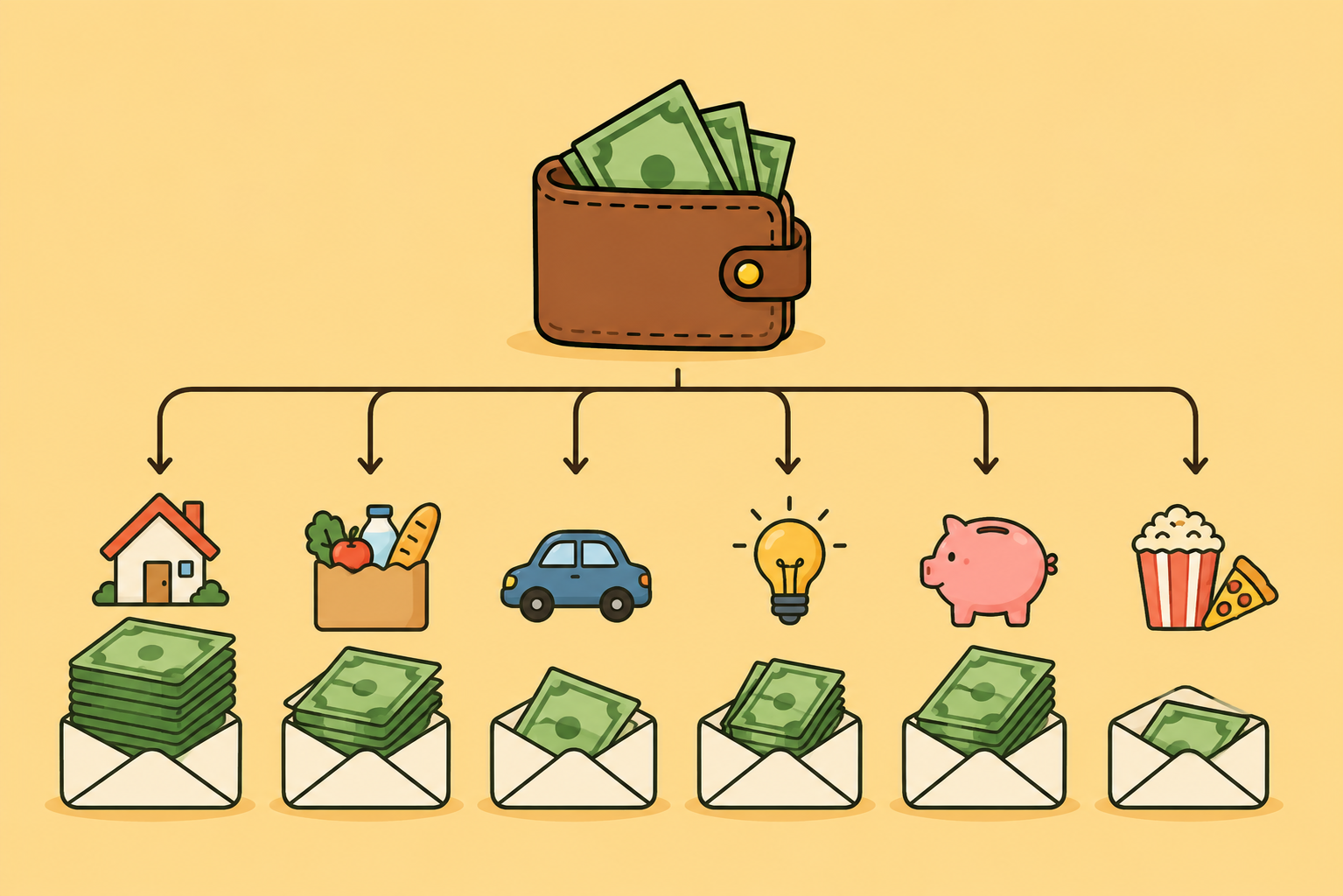
Do you actually know how much you’re saving?
Moving money into a savings account can feel like progress, but it does not tell you how much you kept. Learn how to measure your real savings.
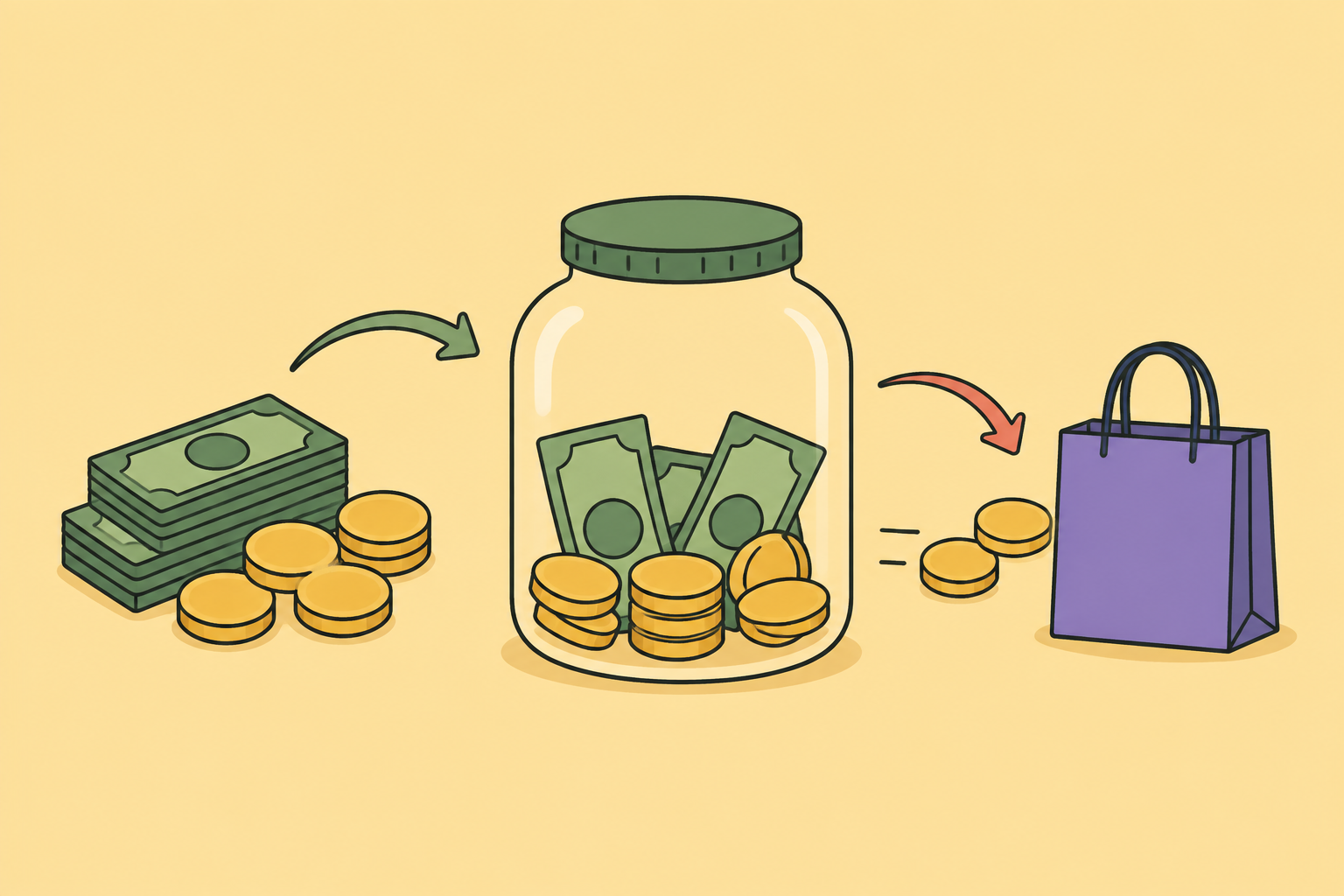
You move money into savings every payday. That feels responsible. Then an unexpected bill arrives, the everyday account runs low and some of the money comes back out.
So how much did you actually save?
I had an automatic transfer to my savings account every week, it made me feel like I was saving well. Yet when I was needing to dip into my savings, I told myself that it was just an insignificant withdrawal and my saving rate was still great. But at the end of the year, my savings account told me otherwise.
The answer is not always the amount you transferred. A savings transfer tells you where your money is sitting. It does not tell you how much of your income you ultimately kept.
Understanding that difference can make saving feel less confusing and give you a more honest view of your progress.
Moving money is not the same as saving it
Imagine you receive $5,000 of income this month and transfer $1,000 into a savings account.
It is tempting to say you saved $1,000. But the transfer only moved money from one account you own to another. Your total amount of money did not increase or decrease when the transfer happened.
What matters is what happened across the whole month.
If you earned $5,000 and spent $4,200, you kept $800. That $800 is your cash saving for the month, regardless of whether you transferred $500, $1,000 or nothing at all into a separate account.
The basic idea is:
Income minus expenses equals cash savings
In this example:
$5,000 minus $4,200 equals $800
Your cash savings rate is the amount you kept as a percentage of your income:
$800 divided by $5,000 equals 16 percent
You do not need to calculate this after every purchase. The purpose is simply to separate genuine progress from moving money between accounts.
What if you take money back out of savings?
Taking money out of a savings account does not automatically mean you failed to save. It depends on what happened next.
You move it back but do not spend it
Suppose you transfer $300 from savings back into your everyday account so an upcoming payment will clear. If that money remains in an account you own, you have only changed its location.
You have not created income, and you have not created an expense.
Your savings account balance is lower, but your total money is unchanged.
You move it back and spend it
Now suppose you move the same $300 back and use it for groceries, a repair or something else you buy.
The transfer still is not the expense. The purchase is.
If you originally expected to keep $800 but later spent another $300, you finished the month keeping $500. That is a more useful measure than the amount you moved into savings on payday.
You spend money you saved for a purpose
Not every withdrawal is bad news.
Perhaps you built a travel fund, saved for annual insurance or put money aside for a new appliance. When you eventually use that money, the savings account falls because the plan worked.
There are two different questions here:
- Did you successfully save for the purchase?
- How much of this month’s income did you keep after spending?
Both are useful, but they measure different things. A goal tracks progress towards a purpose. A cash savings rate measures the gap between income and expenses during a period.
Why the savings account balance can mislead you
A savings account is useful for keeping money away from everyday spending, but its balance is not a complete scorecard.
The balance can rise because you transferred existing money into it. It can fall because you moved money to another account you own. Interest can increase it without coming from this month’s pay. A planned purchase can reduce it even though you followed your plan perfectly.
The balance also ignores what is happening elsewhere. You could add $600 to savings while putting $800 of new spending on a credit card. Looking only at the savings account would make that month appear stronger than it was.
This is why it helps to look at your income, spending, account balances and debts together.
Three numbers answer three different questions
You do not need one perfect number. You need the right number for the question you are asking.
Your savings account balance
This tells you how much money is currently held in that account. It is useful for checking whether you have enough for an emergency fund or planned cost.
Your cash savings rate
This tells you how much of the income recorded for a period remained after expenses. It is useful for understanding whether your day to day pattern is leaving room for the future.
Your net worth
This is everything you own minus everything you owe. It provides a broader view that can include cash, investments, property and debt. It can change for reasons other than saving, such as investment movements, loan interest or changes in asset values.
These figures should support each other, but they will not always move by the same amount.
How Fireball helps you see what you kept
Fireball brings income and categorised expenses together to calculate your Cash Savings Rate.
Open Insights, then choose Cash Savings Rate to see the available monthly view and trend. Fireball calculates cash savings as income minus expenses, then divides that amount by income to produce the percentage.
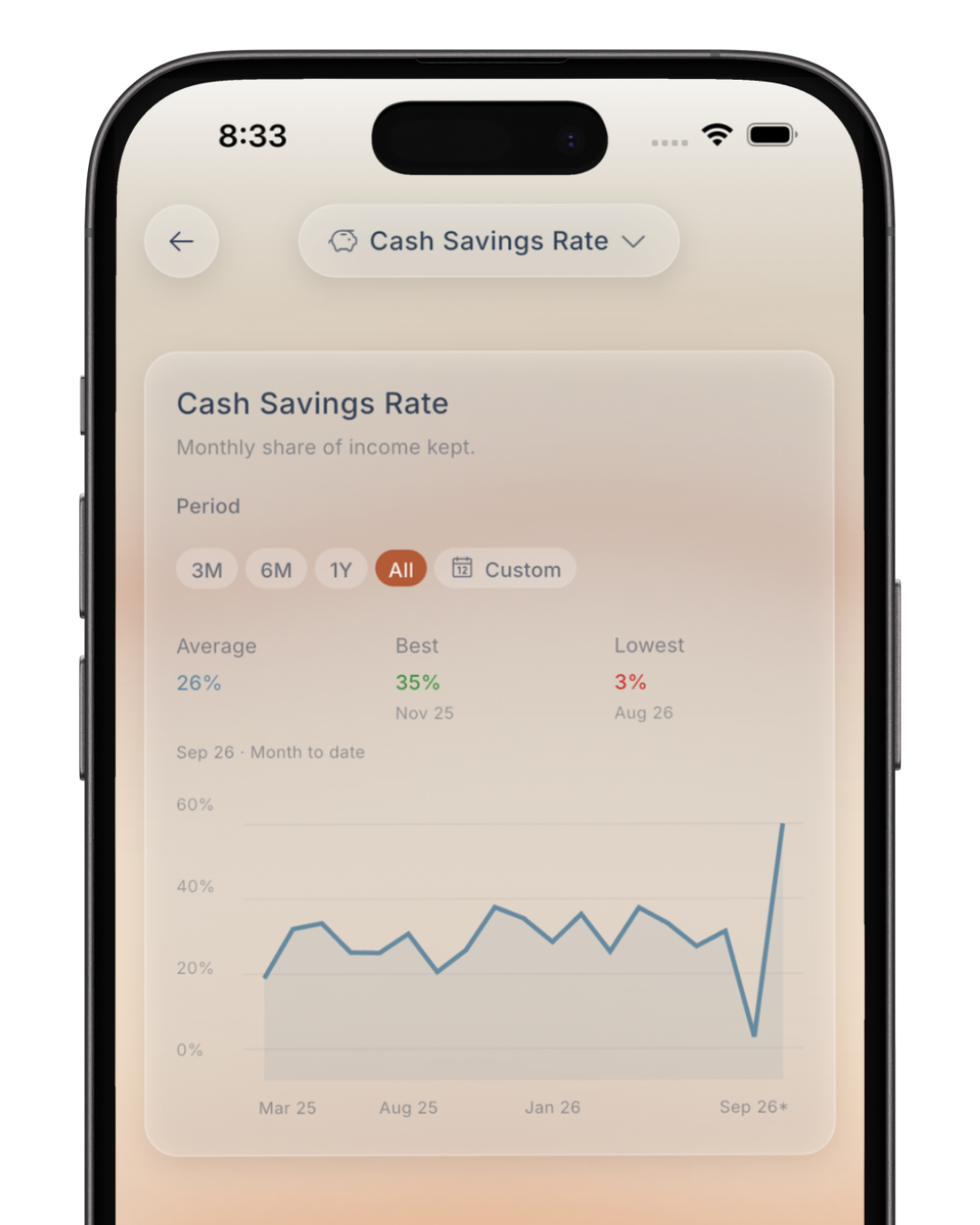
The current month may change as more income and expenses arrive. If regular income has not posted yet, Fireball may show the previous calendar month or explain why a reliable current percentage is not available. A pending income transaction is not counted until it posts.
You can also use:
- Income vs Expenses to compare what came in with what went out.
- Cash Flow to understand money movement during a selected month.
- Net Worth Changes to see how assets and debt affected the bigger picture.
- A Save up goal when money has a specific purpose and you want to track contributions, spending and withdrawals.
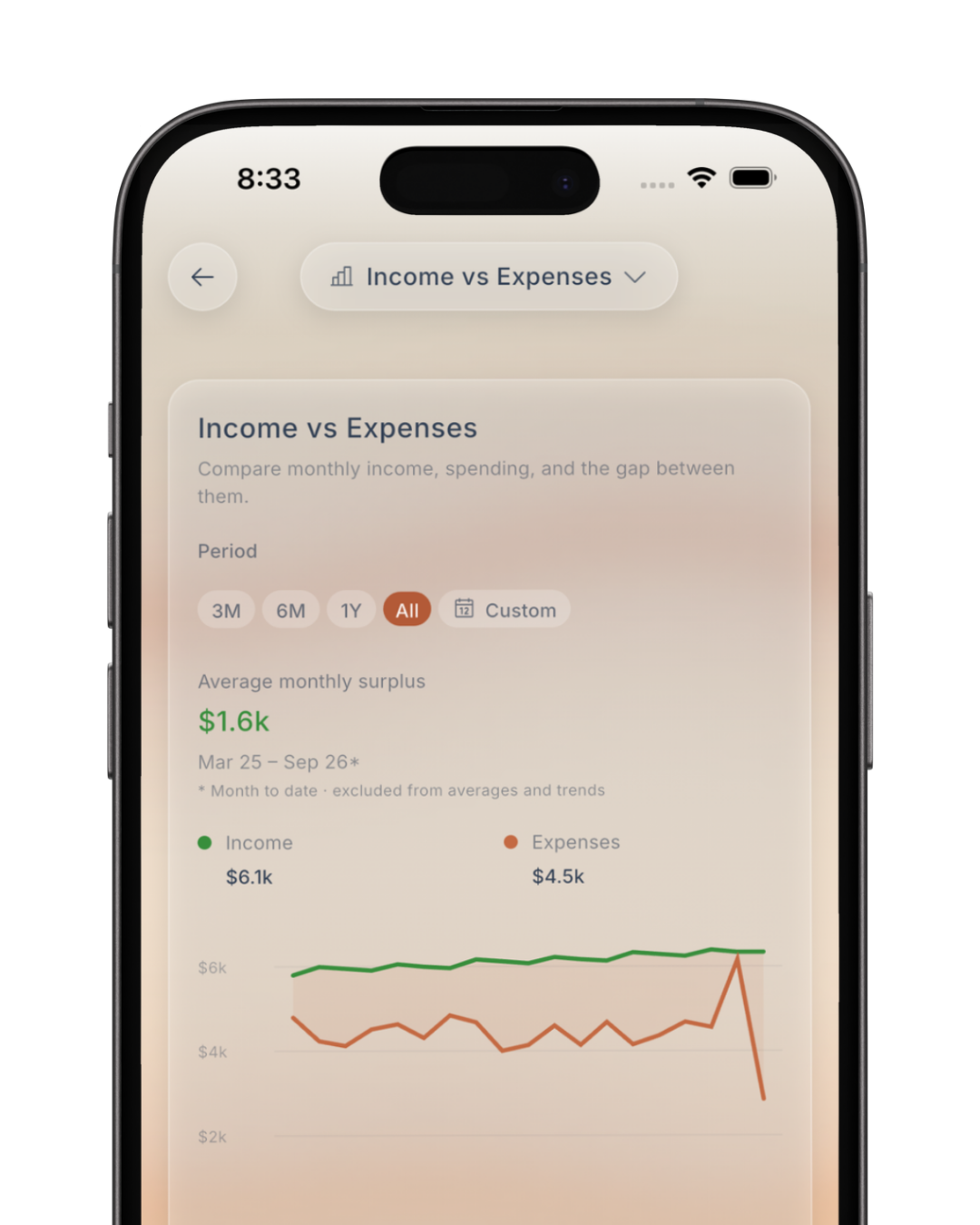
Fireball treats transfers between your own accounts differently from ordinary income and spending. This prevents the same money from appearing to be newly saved every time you move it.
For example, moving $1,000 from an everyday account into savings does not make you $1,000 wealthier. One account falls while the other rises. If you later move $300 back, that is still a transfer. If you then spend the $300, the purchase affects your expenses.
What to check when the number surprises you
A savings rate is only as useful as the activity behind it. If the result does not look right, start with the selected month and then review the transactions that contributed to it.
Check whether:
- Income has been recognised as income.
- Purchases have the correct spending categories.
- Transfers between your own accounts are identified as transfers.
- A pending payday has posted.
- Transactions or accounts are missing or out of date.
Do not change a transaction simply to make the percentage look better. Correct it only when the current category or transfer treatment does not match what actually happened.
If you still cannot explain the result, contact Fireball support rather than guessing which transactions to change.
A simple monthly check
At the end of each month, ask yourself:
- How much income came in?
- How much did I spend?
- How much remained after that spending?
- Did my total cash, investments and debt move in the direction I expected?
- Did I use any saved money for the purpose I intended?
You are looking for a pattern, not a perfect month. Some months will include annual bills, travel, repairs or other planned costs. A lower savings rate in one month does not erase the work that made those costs manageable.
Saving is what remains, not what moves
Moving money into a separate account is still a valuable habit. It creates distance from everyday spending and gives your goals a visible home.
Just do not confuse the transfer with the result.
The amount you actually save is what remains after income and expenses are considered together. Once you can see that clearly, you can make calmer choices about spending, set more realistic goals and recognise genuine progress.
Related reading
- How much should I save each month?
- How much should your emergency fund be?
- Understand your net worth and financial insights
- Create and track a Save up goal
Make the next money decision calmer
Turn what you just read into a plan you can track, adjust, and actually live with. Explore our free financial calculators or see how Fireball brings your finances together.