How much should I have in savings at my age in New Zealand?
Wondering whether you have enough saved for your age? Learn what to count, why generic milestones can mislead, and how to set a target that fits your life in New Zealand.
It is an uncomfortable question because it sounds as though there should be a simple answer.
How much should you have saved by 25? What about 30, 40 or 50? If someone your age owns a home and has a much larger KiwiSaver balance, does that mean you are behind?
The short answer is that there is no single correct savings balance for your age.
Age matters, but so do income, housing, debt, children, health, when you started saving and what you want your money to do. A useful savings target should reflect your life, not turn somebody else's circumstances into a scorecard.
You can still work out whether you are making enough progress. The first step is deciding what you mean by savings.
Savings is not just one number
When people compare savings, they are often comparing different things without realising it.
One person might mean the cash in their savings account. Another might include KiwiSaver and investments. Someone who owns a home might be thinking about their equity. Someone else may count everything they own but forget to subtract debt.
It helps to separate your money into four views.
Accessible savings
This is money you can use when you need it. It may include an emergency fund, an income buffer and cash saved for near term expenses.
Accessible money matters because KiwiSaver or home equity will not usually pay an unexpected power bill or cover your rent after a sudden loss of income.
Savings for planned goals
This is money with a purpose, such as travel, a first home deposit, study, a wedding, a car or an annual insurance bill.
You are not failing when you eventually spend it. Using the money for its intended purpose means the savings plan worked.
Long term investments
This may include KiwiSaver, managed funds, shares and other investments intended for your future.
KiwiSaver is part of your wealth, but it is not the same as accessible cash. It is generally available at 65, with limited permitted withdrawals such as an eligible first home withdrawal. You can check the current rules directly with Inland Revenue.
Net worth
Your net worth is everything you own minus everything you owe.
It can include cash, KiwiSaver, investments, property and other assets, less a mortgage, credit card balances, personal loans and other debts.
Net worth gives you the broadest picture. It is not the same as the amount you can safely spend or the cash you have ready for an emergency. In Fireball, Net Worth combines supported accounts with manual assets and debts so you can see that wider picture in one place.
Why a savings target based only on age can mislead you
Rules such as having a certain multiple of your salary saved by a particular birthday look reassuringly precise. The problem is that the same rule can mean very different things for different people.
Consider two people who are both 35.
One has a steady salary, no dependants and a home bought several years ago. The other recently changed careers, supports children and pays rent in Auckland. Their useful savings targets will not be the same.
A salary based rule can also make a pay rise look as though you have suddenly fallen behind, even though your financial position has improved. It may ignore expensive debt, the accessibility of your money and whether your savings are meant for next year or retirement.
Your age is best treated as context. It tells you roughly how much time you may have for long term money to grow. It does not tell you what your life should look like.
What New Zealand data shows
There is no reliable national table showing how much cash people have in ordinary savings accounts at every age. Two datasets can still provide useful context: individual net worth and KiwiSaver balances.
They measure different things, so do not add them together. KiwiSaver is already included when net worth is calculated.
Median individual net worth by age
Stats NZ estimates the following median individual net worth figures for the year ended June 2024:
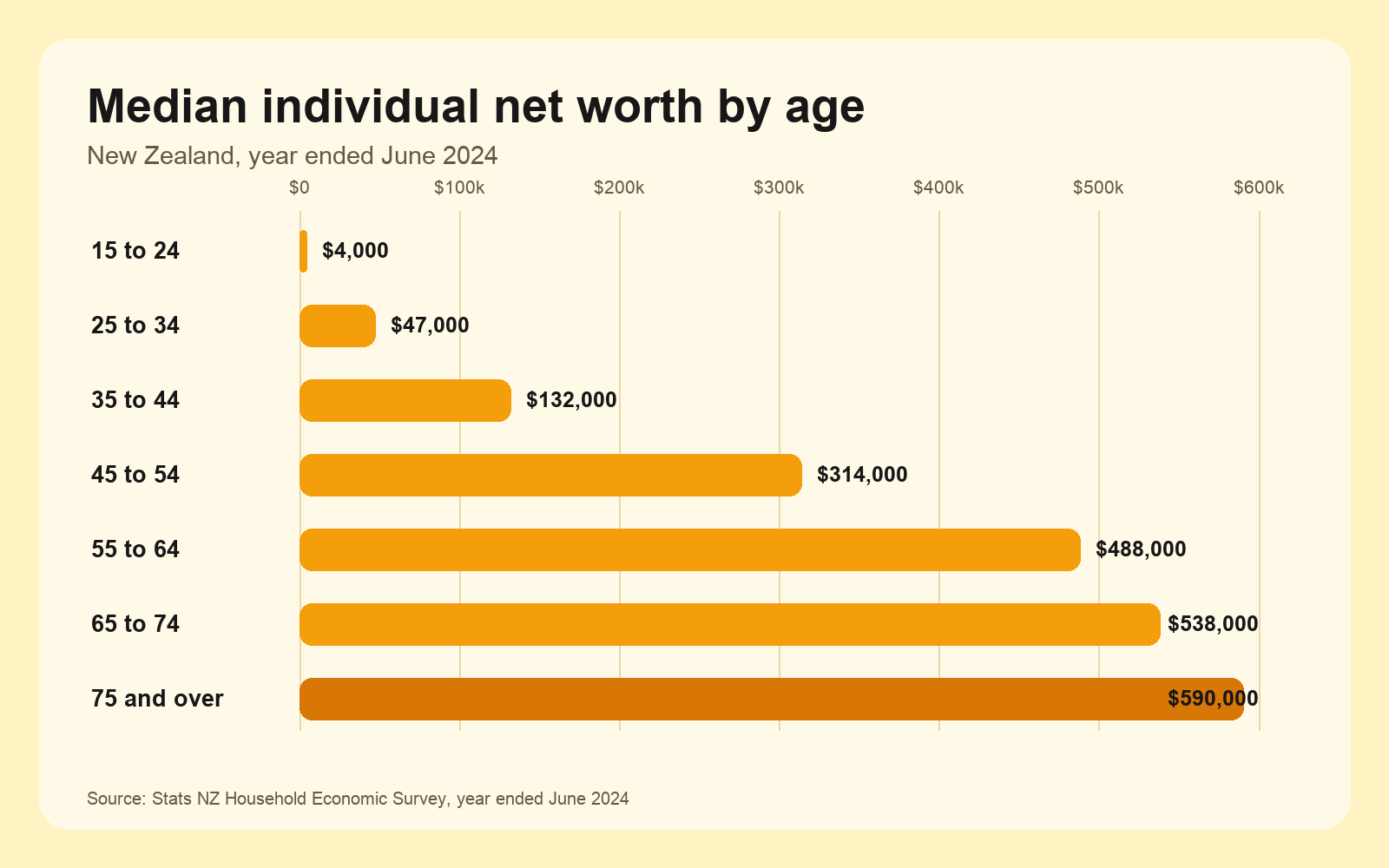
These figures come from the Stats NZ Household Economic Survey for the year ended June 2024. The age table is also available in a more accessible format from Figure NZ.
The median is the middle person in each age group. Half had a higher net worth and half had a lower net worth. It is usually more useful than an average when a smaller number of very wealthy people could pull the result upwards.
This is net worth, not cash savings. It includes assets such as property, investments and retirement savings, then subtracts liabilities such as mortgages and other debt. Someone can have a high net worth while keeping relatively little money in an accessible savings account.
Average KiwiSaver balance by age
The Retirement Commission reported these average KiwiSaver balances at 31 December 2025:
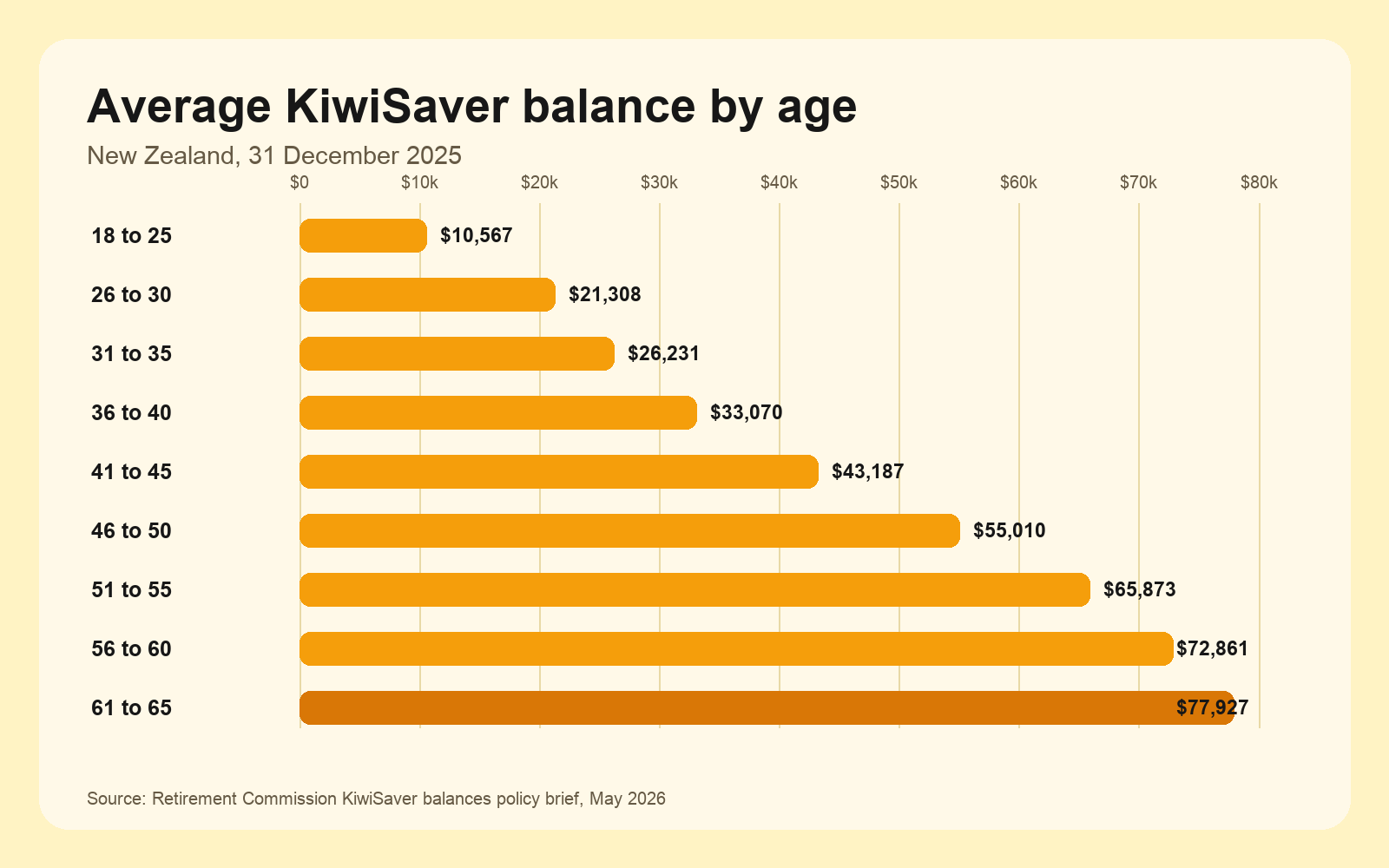
Across all ages, the average was $41,286. Contributing members averaged $50,727, compared with $19,553 for members who were not contributing. The full figures and methodology are in the Retirement Commission's May 2026 KiwiSaver balances policy brief.
These are averages, not targets. They combine people with different incomes, contribution histories, fund choices, career breaks and first home withdrawals. A balance below the average does not by itself mean your plan is failing. A balance above it does not prove you have enough for the retirement you want. If your KiwiSaver account is connected, Fireball includes its current balance in Net Worth and keeps it restricted until age 65 in your FIRE Plan. If future contributions are not already visible in Fireball transactions, add the yearly amount in FIRE settings and do not enter the same contributions twice.
How to use these numbers without turning them into a score
Use the figures to understand the range of real New Zealand outcomes, then return to your own questions:
- Do you have accessible money for an emergency?
- Are expensive debts moving down?
- Are your KiwiSaver and other long term investments moving towards your retirement goal?
- Is your overall net worth generally improving over time?
The trend and the job each part of your money needs to do matter more than matching one national figure.
Useful priorities at different ages
These are prompts, not deadlines. You can start any of them at any age.
In your 20s
The most valuable progress may be building a foundation. Fireball's Cash Savings Rate shows how much recorded income remains after categorised spending, while transfers between your own accounts are not counted as new savings.
Start with a small accessible buffer, learn where your money goes and avoid letting expensive consumer debt grow unnoticed. If you contribute to KiwiSaver, understand your contribution settings, fees and fund rather than checking only the balance.
You may not have a large balance yet, and that is normal. A repeatable habit and time to compound can be more important than reaching an impressive number quickly.
In your 30s
Your goals may begin competing with one another. You might be building an emergency fund while saving for a home, supporting a family, repaying debt and contributing to retirement.
Separate those goals so one balance does not have to do every job. In Fireball, give an emergency fund, home deposit or other planned purchase its own Save up goal with an amount and timeframe. Check that you still have accessible money for surprises, not only KiwiSaver or home equity. If your income rises, decide how much of the increase you want to keep before regular spending quietly expands.
In your 40s
This can be a useful time to look beyond account balances and check the direction of your whole financial position. Fireball's Net Worth History helps you follow the combined movement of your cash, KiwiSaver, investments, property and debts. It begins with the history available after those accounts and manual items are added, so it cannot recreate earlier net worth.
Are debts with high interest rates falling? Is your net worth generally growing over several years? Are retirement contributions likely to support the lifestyle you want? Do you have enough accessible cash to avoid undoing long term investments when life changes?
You still have time to adjust. A clear gap is useful information, not a verdict.
In your 50s
The retirement plan usually becomes more concrete. Instead of asking only how much people your age have, estimate what your own future spending may be and where that income could come from.
Include KiwiSaver, other investments, expected NZ Super, debt, housing and the age at which each source becomes available. If you hope to stop paid work before 65, pay particular attention to the money available before KiwiSaver and NZ Super are accessible.
In Fireball, open FIRE Plan to compare your target retirement age and spending with your KiwiSaver, other investments, debts and planning assumptions. Use the what if options to see how changing your retirement age, future saving or spending could affect the projection. It is a planning estimate, not a promise.
In your 60s and beyond
The question begins to shift from how much you have accumulated to how the money will support you.
Think about regular income, accessible reserves, large future costs and how long invested money may need to last. Your home may contribute to your net worth, but decide whether you actually plan to sell, downsize or borrow against it before treating that equity as retirement spending money.
Planning does not stop when you retire. The balance between spending confidently now and protecting your later years can be reviewed as your circumstances change.
Build a target that belongs to you
A practical savings target has three parts.
1. Your safety buffer
Work out the essential monthly costs you would still need to cover if income stopped or an unexpected expense arrived.
We suggest beginning with a smaller emergency fund, such as $1,000, then working towards three to six months of expenses over time. The right amount depends on factors such as job security, dependants, insurance and how easily you could reduce costs.
Starting with $100 or $500 is still progress if a larger target feels impossible today. Once you choose the amount you need, a Fireball Save up goal can track the target and timeframe without mixing it with everyday spending.
2. Money for known goals
List the larger expenses you expect over the next few years. Give each one an amount and a date.
For example, if you want $6,000 for a course in two years and already have $1,200, the remaining $4,800 can be divided across the time available. This is more useful than comparing your total bank balance with someone the same age.
Keep this money separate from the emergency fund. In Fireball, create a separate Save up goal for each important purchase so you can see what the money is for and how much remains. A predictable annual bill is not an emergency.
3. Your long term plan
Think about the lifestyle you want later, when you may want to reduce or stop paid work. Estimate the spending it could require, then consider KiwiSaver, other investments, NZ Super and any other expected income.
Fireball's FIRE Plan turns these details into a projection and lets you test what if scenarios. It is not a promise. Returns, inflation, income and plans can change, so review the assumptions regularly instead of treating the first result as permanent.
Your current target is simply the next gap you can act on. It might be another $500 of emergency savings, clearing a credit card, increasing regular contributions or learning whether your retirement plan is on track.
An example of why the total alone is not enough
Imagine Maia is 32 and has:
- $4,000 in bank savings
- $28,000 in KiwiSaver
- A $6,000 credit card balance
If Maia says she has saved $32,000, that is true in one sense. But it does not describe what the money can do.
Only $4,000 is readily accessible. Most of the KiwiSaver money is intended for later and is subject to withdrawal rules. After subtracting the credit card debt, these three items contribute $26,000 to net worth.
Suppose Maia decides that $8,000 would provide a suitable emergency buffer. Her most useful next targets may be building another $4,000 of accessible savings and dealing with the expensive credit card debt. Comparing herself with another 32 year old would not reveal either priority.
What if you feel behind?
First, check that the comparison is fair. A person sharing a savings balance may not mention help from family, a partner's income, an inheritance, their debt or when they bought a home.
Then replace the comparison with a next step you can control.
- Record what you own and what you owe.
- Check how much accessible cash you have.
- Choose one safety or goal target.
- Use Fireball's Cash Savings Rate to check how much recorded income remains after categorised spending.
- Automate an amount you can repeat.
- Review the result after a few months.
If debt repayments or essential costs leave no room to save, that does not mean you need more discipline. The immediate problem may be cash flow, debt cost or insufficient income.
How Fireball can help you measure progress
Fireball brings your supported bank accounts, KiwiSaver, investments, property, other assets and debts into one financial picture.
You can use:
- Net Worth to see what you own minus what you owe.
- Cash Savings Rate to see how much recorded income remained after categorised expenses, rather than counting transfers between your own accounts as new savings.
- A Save up goal to give an emergency fund or planned purchase its own amount and timeframe.
- Compare Net Worth to view the comparison information available in Fireball as context, without treating it as a personal target.
- Your FIRE Plan to test how spending, retirement timing, KiwiSaver, other investments, debt and planning assumptions could affect your longer term path.
These views answer different questions. A growing net worth does not guarantee that you have accessible emergency money. A strong KiwiSaver balance does not necessarily fund an early retirement before it can be withdrawn. A savings account transfer does not show how much of your income you ultimately kept.
Looking at them together gives you a more useful answer than one age based benchmark.
Common questions about savings by age in New Zealand
How much should I have saved by 25 in New Zealand?
There is no required amount. A useful focus at 25 is building a starter emergency buffer, understanding your KiwiSaver and creating a regular saving habit. If you are studying, beginning work or paying down debt, your balance may be small while your foundation is still improving.
How much should I have saved by 30?
Instead of using one salary multiple, check whether you have accessible emergency money, a plan for near term goals and some long term retirement saving underway. Include debt when judging your overall position.
How much should I have saved by 40?
At 40, the direction of your net worth and retirement projection can tell you more than a generic bank balance. Review cash, KiwiSaver, investments, property and debts together, then identify the gap most relevant to your plans.
Does KiwiSaver count as savings?
Yes, KiwiSaver is part of your wealth and long term savings. It should not be treated as ordinary emergency cash because access is restricted. Keep it visible while tracking accessible savings separately.
Does home equity count as savings?
Home equity contributes to net worth, but it is not cash in a savings account. It can support a future plan only if you have a realistic way to use it, such as selling, downsizing or another deliberate strategy.
Should I save or pay off debt first?
The answer depends on the debt, its cost and your need for an emergency buffer. A small cash reserve can help stop the next surprise going back onto a credit card. Expensive debt may then deserve priority. If you are unsure, seek personalised financial advice or free financial mentoring rather than relying on a generic age target.
The right number is the one with a job
You do not need to win a comparison with everyone born in the same year.
You need enough accessible money to make setbacks manageable, enough planned savings for the goals that matter to you and a long term plan that is moving in the right direction.
Start with the next useful number. Once you reach it, choose the next one. That is how a savings target becomes progress instead of pressure.
Make the next money decision calmer
Turn what you just read into a plan you can track, adjust, and actually live with. Explore our free financial calculators or see how Fireball brings your finances together.