Why paying off credit card debt feels harder than it should
42% of New Zealanders carry credit card debt. Most know they have it, know the interest is high, and still find it hard to shift. Here's why the balance barely moves, and what actually helps.
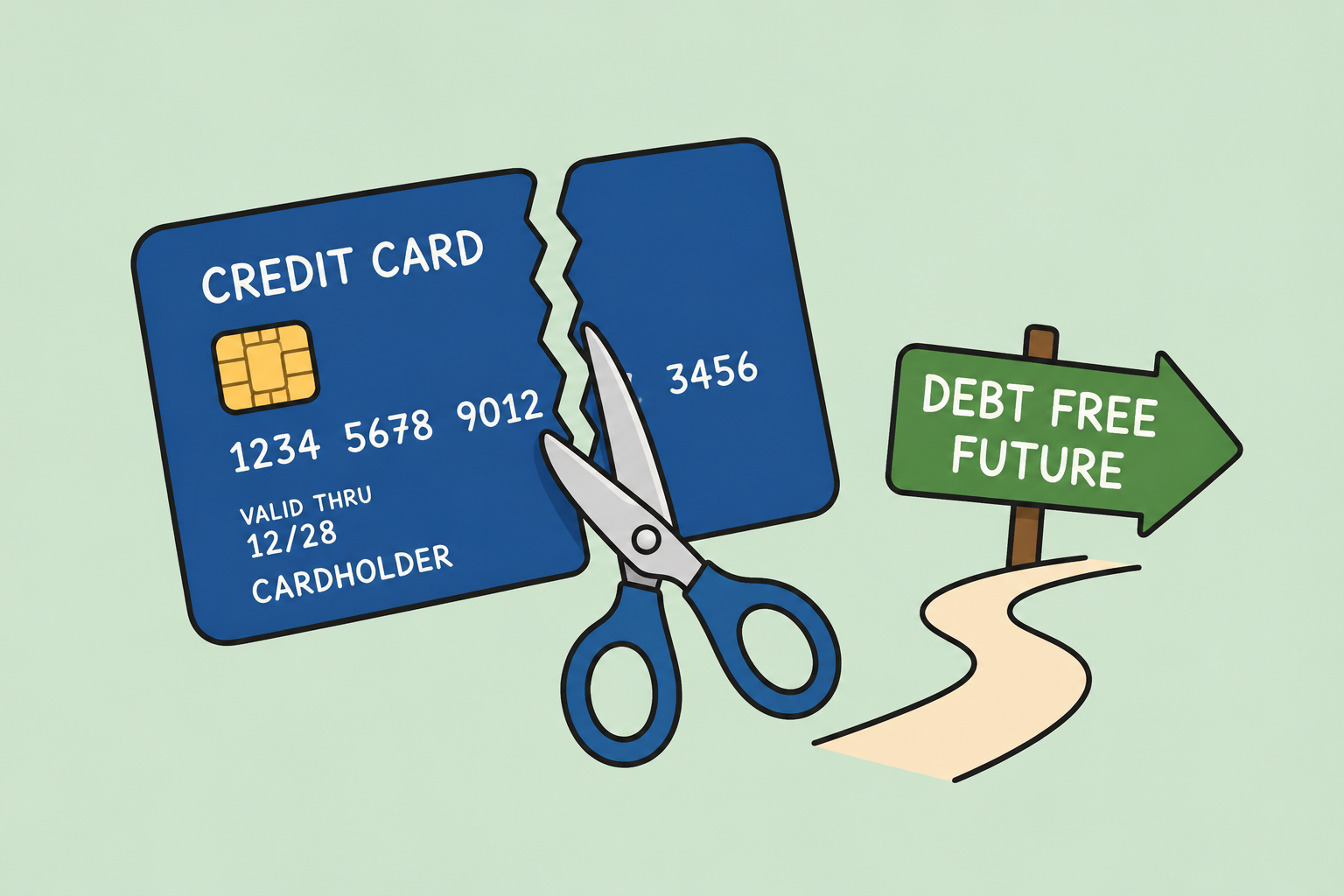
Paying off credit card debt is mostly a maths problem. It doesn't feel like one.
Credit card debt is more common than most people realise. According to the OneChoice Generation Debt Report 2025, 42% of New Zealanders carry credit card debt, making it the most widespread form of debt in the country, ahead of mortgages and personal loans. Around 470,000 Kiwis are currently behind on consumer debt payments.
Most people who carry a balance know they have it. They know roughly how much. They probably know the interest rate is high. What's harder to sit with is the feeling of it — the low-grade awareness that a chunk of every payment is going straight to the bank, that the balance barely moves, that the thing you bought six months ago is still somehow following you around.
That feeling is worth naming, because it's part of why credit card debt is hard to shift. It's demoralising in a way that other financial problems aren't. A mortgage feels like progress. Credit card debt feels like evidence of something.
It isn't, really. Most people end up carrying a balance because of a bad month, an unexpected bill, a period where income dropped or expenses spiked. The debt accumulates quickly and pays down slowly, which is by design, and the guilt that sits alongside it tends to make people avoid looking at it directly. Which makes it worse.
The practical stuff matters too, but it helps to start here.
Why the balance barely moves
Two things work against you when you carry a credit card balance: how the interest is calculated, and how minimum payments are structured. Understanding both makes it easier to see why the debt moves so slowly.
Compounding interest. The average credit card interest rate on interest-bearing balances in New Zealand is around 19.7%, a figure that has barely moved in twenty years according to Reserve Bank data. What most people don't realise is that this isn't charged once a year — it compounds daily. Each day, the bank calculates interest on your current balance, including any interest already added. So on a $5,000 balance, you're paying roughly $2.70 in interest on day one. On day two, the interest is calculated on $5,002.70. Small amounts, but they add up fast, and if you're not paying down the principal meaningfully each month, the balance barely moves even while you're making payments. Collectively, New Zealanders pay around $557 million in credit card interest each year, all of it going straight to bank revenue.
The minimum payment trap. Banks set minimum payments low, typically around 2–3% of the outstanding balance or a small fixed amount, whichever is higher. On a $5,000 balance that might be $100–$150 a month. It feels manageable, and that's the point. Pay only the minimum on a $5,000 balance at 19.7%, and the debt takes well over a decade to clear and costs more than the original balance in interest alone by the time it's done. The minimum payment keeps you in the relationship as long as possible. It's not a repayment plan. It's a floor.
The way out of both problems is the same: pay more than the minimum, consistently, and don't add to the balance while you're paying it down.
Two approaches worth knowing
Once you've decided to tackle the debt properly, the two most common strategies are the avalanche and the snowball. They're not complicated, but they suit different people.
The avalanche means paying off the card with the highest interest rate first, while making minimum payments on everything else. Once that's cleared, you redirect the full payment toward the next highest rate, and so on. Mathematically it's the most efficient approach — you pay less interest overall and clear the debt faster. If you can stay motivated by knowing you're doing the optimal thing, this is probably the better choice.
The snowball means starting with the smallest balance regardless of interest rate, clearing it completely, then rolling that payment into the next smallest. It's slightly less efficient in pure interest terms, but it produces early wins. Some people find that paying off a card completely, even a small one, changes how the whole project feels. The psychological lift is real and it keeps people going. If you've tried the avalanche before and lost momentum, the snowball might actually get you further.
Neither is wrong. The best method is the one you stick with.
Compare your payoff options in Fireball
If you are comparing debt payoff apps in New Zealand, look for one that does more than display the balance. Fireball's Debt Planner can compare three plans using the balances, interest rates, and repayments you review in the app, so you do not have to work out the best order with a spreadsheet.
- Current order follows the order created by your existing repayments.
- Highest rate first directs extra money towards the debt with the highest interest rate. This is the avalanche approach.
- Smallest balance first directs extra money towards the smallest debt. This is the snowball approach.
You can also test an extra amount each month, a one off payment, or both. For each plan, Fireball shows the estimated time until you are debt free and the total interest in the projection. This makes the choice more concrete. You can see whether the interest saved by the highest rate plan matters more to you than the earlier win offered by the smallest balance plan.
Once you choose a plan, Fireball can include the planned debt payments in Budget. It does not send money to your lender or change an automatic payment. It reserves the amount in your plan so the rest of your budget reflects what you intend to pay.
The estimate assumes the rates and repayments you entered stay the same. It does not include new card spending, fees, penalties, or later repayment changes. Update the plan when your card balance, rate, or affordable payment changes.
The best debt payoff app is the one whose numbers you understand and whose plan you can realistically follow. Fireball is a strong fit for New Zealanders who want their credit cards and other debts compared alongside their real budget, rather than treated as a separate calculator.
Before throwing everything at the debt
A few things are worth sorting before picking a strategy and committing to it.
Start by getting a clear picture of what you actually owe. Write down each card, its balance, its interest rate, and the minimum payment. Most people have a rough sense of this but haven't looked at all of it together in one place. Seeing the full picture is uncomfortable, but it's also what makes the strategy decision easier , you can't pick between avalanche and snowball without knowing which card has the highest rate and which has the smallest balance. If your accounts are connected in Fireball, your card balances are already visible in one place and update automatically, so you're not relying on logging into three different bank apps.
Stop adding to the balances. This sounds obvious but it's where a lot of repayment attempts quietly fail. If you're paying down a card while still using it for regular spending, the balance doesn't move meaningfully and the whole effort feels pointless. During repayment, it helps to either stop using the card entirely or switch to debit for day-to-day spending. The goal is for the balance to have one direction: down.
An emergency fund matters even while paying off debt. It sounds counterintuitive to keep savings sitting at 4% when the debt is costing nearly 20%, but without a small buffer, any unexpected expense goes straight back onto the card. A month's worth of essential expenses in a separate account breaks that cycle. It doesn't need to be more than that while you're in repayment mode — building a larger emergency fund can come after the debt is cleared.
A balance transfer is worth considering if you have a reasonable credit history. Several NZ providers offer 0% introductory rates on balance transfers for six to twelve months, which means every dollar you pay during that period goes toward the principal rather than interest. The main thing to watch is the revert rate, the standard rate that kicks in once the introductory period ends, which is typically back up around 20%. You also can't transfer to a card from your existing bank, so you'll need to apply with a different provider. If the balance isn't cleared before the introductory period ends, the savings can evaporate quickly.
The budget piece
Paying off debt faster requires finding extra money somewhere, and that usually means knowing where the current money is going. Most people in debt are also running a rough mental budget that isn't quite accurate — the spending estimate in their head is lower than what the bank records show.
Connecting your accounts in Fireball gives you the actual numbers rather than the estimated ones. The debt payoff timeline it shows is based on your real cashflow, which tends to change the picture. Sometimes the gap between what you thought you had available and what you actually have is bigger than expected in a useful direction.
The part nobody talks about much
Paying off credit card debt takes longer than people hope and shorter than they fear, usually. The middle stretch is the hardest — the balance is moving but slowly, the end isn't quite in sight, and the discipline required starts to feel like it has no end date.
This is where most attempts stall. Not at the start, when motivation is high, and not near the end, when the finish line is visible. In the middle.
A few things help. Tracking the balance somewhere you can see it, not to obsess over it but so progress is visible — Fireball shows your debt balance over time, so the downward trend is visible even when individual months feel slow. Giving yourself a specific target date rather than a vague intention. Keeping the automatic payment higher than the minimum so something is happening even in the months where you don't think about it.
The debt is a maths problem. But finishing it is mostly about staying in it long enough for the maths to work.
Make the next money decision calmer
Turn what you just read into a plan you can track, adjust, and actually live with. Explore our free financial calculators or see how Fireball brings your finances together.