How much should you contribute to KiwiSaver: 3.5%, 4% or more?
The KiwiSaver contribution rates you can choose, what each one takes from your pay, and how to decide between the 3.5% default and a higher rate.
For most employees, contributing at least the 3.5% default is worth it, because your employer must match it and the government adds up to $260.72 a year. Whether to go higher depends on your debts, your emergency savings, your age and whether you want money you can reach before 65.
Disclosure: this guide is published by Fireball, a budgeting app for New Zealand. It explains the rules and the trade offs. It is general information, not personal financial advice, and it does not recommend a rate for you. Rates and rules were checked with Inland Revenue on 5 October 2026.
What KiwiSaver contribution rates can you choose?
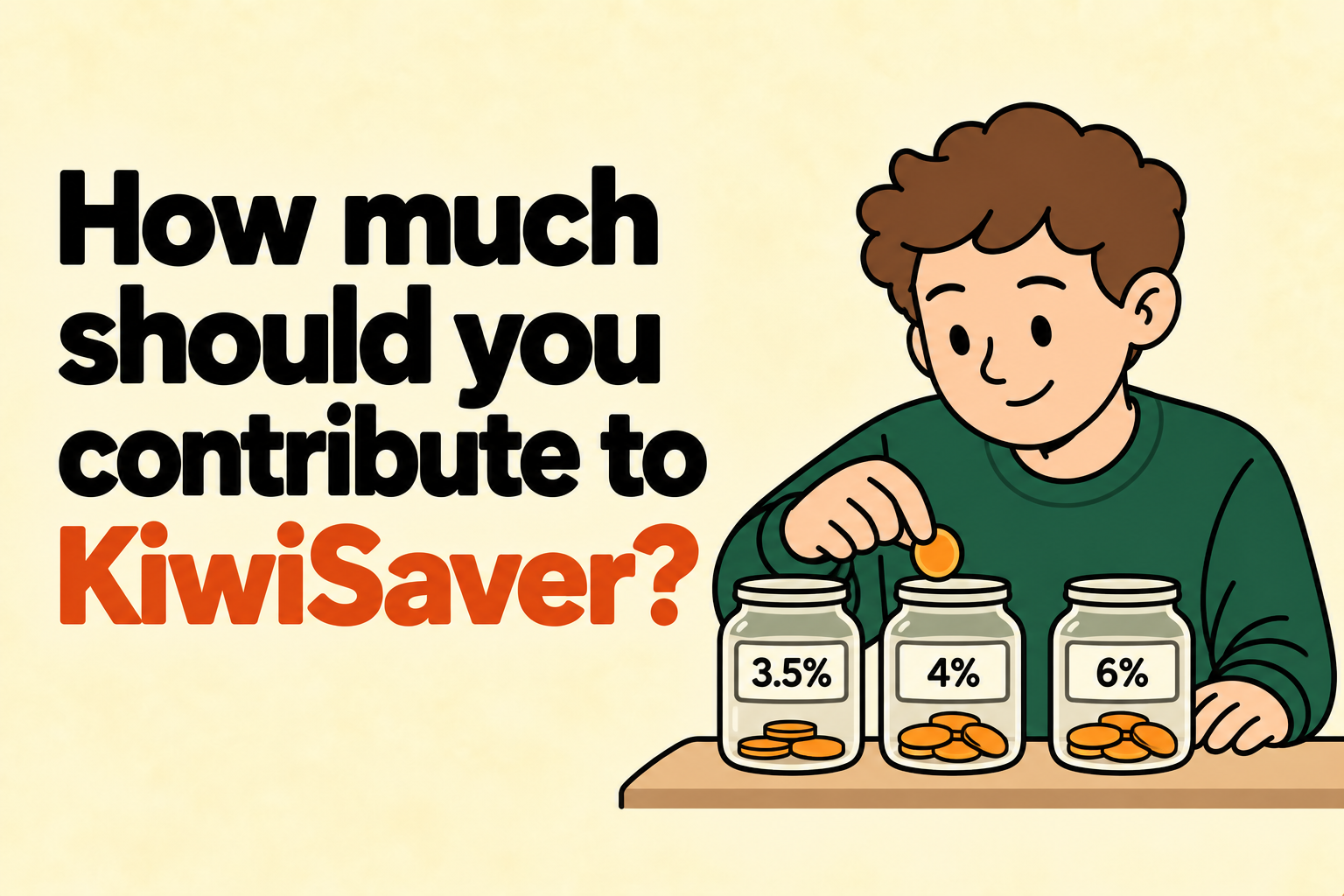
Employees can choose 3.5%, 4%, 6%, 8% or 10% of gross pay. Inland Revenue says that if you do not choose, your employer deducts the default rate of 3.5%.
The default rose from 3% to 3.5% on 1 April 2026. Sorted explains that it rises again to 4% in April 2028.
Your contribution is worked out on your gross pay but comes out of your pay after tax, so your take home pay falls by the full amount.
How much does each rate take from your pay?
This table shows the employee contribution each fortnight for three salaries.
| Rate | $60,000 salary | $80,000 salary | $100,000 salary |
|---|---|---|---|
| 3.5% | $81 | $108 | $135 |
| 4% | $92 | $123 | $154 |
| 6% | $138 | $185 | $231 |
| 8% | $185 | $246 | $308 |
| 10% | $231 | $308 | $385 |
Moving from 3.5% to 4% on an $80,000 salary costs about $15 a fortnight. Moving from 3.5% to 6% costs about $77 a fortnight.
Why is the default rate usually worth contributing?
Because two other people add money when you do.
- Your employer matches at least 3.5%. Inland Revenue says the lowest employer rate is 3.5% of your gross pay. Employer contributions are taxed before they reach your account. If you stop contributing, your employer can stop too.
- The government adds up to $260.72 a year. Inland Revenue says it contributes 25 cents for each dollar you put in, up to $260.72. You need to contribute about $1,043 in the year to get all of it. You do not qualify if your taxable income is more than $180,000.
On an $80,000 salary, 3.5% from you is $2,800 a year. Your employer adds another $2,800 before tax, and the government adds $260.72. Few other savings options add that much to each dollar you put in.
When does contributing more than 3.5% make sense?
A higher rate can suit you when the basics are already covered.
- You have no high interest debt. Paying off a credit card usually beats any investment return.
- You have an emergency fund. KiwiSaver cannot be used for a car repair or a gap between jobs.
- You are behind on retirement savings. A higher rate later in your career can help close a gap.
- You would spend the money otherwise. KiwiSaver comes out before you see it, which makes it a reliable way to save.
- You will not need the money before retirement. A higher rate can make sense if you have enough savings outside KiwiSaver for upcoming costs and want to put more aside for retirement.
Check your employment agreement first. Most employers only match the minimum, so the extra you contribute above 3.5% is usually your money alone.
When is a higher rate not the best choice?
More KiwiSaver is not always better, because the money is locked away.
- You may need it before 65. Inland Revenue says you can withdraw your savings once you reach the age of eligibility, currently 65. Earlier access is limited to cases such as buying a first home or significant financial hardship.
- You want to stop work early. If you plan to retire or cut back before 65, you need savings outside KiwiSaver to live on until then.
- Your budget is already tight. A higher rate that pushes you onto a credit card costs more than it earns.
- You are paying off expensive debt. Clear that first, while keeping the 3.5% that earns the employer match.
A common middle path is to stay at the default in KiwiSaver and invest any extra somewhere you can reach.
Can you contribute less than 3.5%?
Yes, for a while. Inland Revenue says a temporary rate reduction lets you keep contributing at 3%, and you can apply for between 3 and 12 months. If you are on a temporary rate reduction, your employer can choose to lower its contribution to 3% as well.
Use it as a short term measure. Each year at a lower rate is a year of smaller contributions from you and possibly from your employer.
What if you are self employed?
You have no employer contribution and no set rate, so you decide how much to pay in. The government contribution still applies. Putting in about $1,043 a year earns the full $260.72, which is a useful minimum to aim for.
How do you decide on a rate?
Work through these four steps.
- Confirm you are getting the full employer match and the full government contribution. If not, fix that first.
- Check your budget for the next few months. Use the table above to see what a higher rate takes each fortnight.
- Deal with high interest debt and build an emergency fund before raising your rate.
- Decide how much of your long term saving should be locked until 65 and how much you want within reach.
Review the decision when your pay changes, when you pay off a debt or when your plans for retirement change.
How do you change your contribution rate?
Tell your employer which rate you want, and they will change your deductions. You can change your rate again later. Your KiwiSaver provider can also take extra payments directly if you want to add a lump sum without changing your rate.
Will the rules change again?
They may. The default is already set to rise to 4% in April 2028, and KiwiSaver is often debated at election time. This guide describes the rules in force on 5 October 2026. The way to decide does not change: take the matched money first, then weigh locked savings against savings you can reach.
How Fireball can help
Fireball is our own app, so treat this as a description.
Fireball shows your KiwiSaver balance from supported providers beside the rest of your net worth, and its financial independence projection includes KiwiSaver, the age you can access it and NZ Super. That makes it easier to see how a different contribution rate changes your plan and how much you would need outside KiwiSaver to stop work earlier. Our KiwiSaver gap calculator is free and shows how far KiwiSaver and NZ Super may fall short of the retirement you want.
Common questions
How much should I contribute to KiwiSaver?
At least the 3.5% default if you are an employee, so you receive the employer match and the government contribution. Whether to contribute more depends on your debts, your emergency savings and whether you want money you can reach before 65.
What is the KiwiSaver contribution rate in 2026?
The default employee rate is 3.5% of gross pay from 1 April 2026, and employers must contribute at least 3.5% as well. Employees can also choose 4%, 6%, 8% or 10%.
Is it worth contributing more than the minimum to KiwiSaver?
It can be, if you have no high interest debt, you have an emergency fund and you do not need the money before 65. Most employers only match the minimum, so contributions above it are usually your money alone.
Does my employer have to match my KiwiSaver contribution?
Your employer must contribute at least 3.5% of your gross pay while you are contributing. It does not have to match a higher rate unless your employment agreement says so.
How much is the KiwiSaver government contribution?
The government contributes 25 cents for each dollar you put in, up to $260.72 a year. You need to contribute about $1,043 in the year to receive the full amount, and you do not qualify if your taxable income is more than $180,000.
Can I lower my KiwiSaver contribution to 3%?
Yes, through a temporary rate reduction of between 3 and 12 months. Your employer can choose to lower its contribution to 3% while your reduction is in place.
When can I take money out of KiwiSaver?
Generally from the age of 65. Earlier withdrawals are limited to cases such as buying a first home or significant financial hardship.
The short answer
Contribute enough to get everything on offer from your employer and the government. After that, the right rate is the one that fits your budget and leaves you with enough savings outside KiwiSaver for the years before 65.
Make the next money decision calmer
Turn what you just read into a plan you can track, adjust, and actually live with. Explore our free financial calculators or see how Fireball brings your finances together.